

Simple Trick to Counteract Sudden Lightheadedness

Ever get up from a chair quickly and feel dizzy? Ever stand still for a long time and begin to feel lightheaded? Ever finish a heavy set of squats or deadlifts and feel like you might pass out? These are all examples of when blood pressure suddenly drops, which leads to reduced oxygen delivery to the brain and resultant lightheadedness. It’s normal for healthy individuals to occasionally experience short-lived drops in blood pressure like I just described, and this article will explain a simple trick that can counteract the lightheadedness caused by those sudden blood pressure drops. If you want to skip my anatomy & physiology preamble, scroll to the last section of this article for the TL;DR explanation of the simple trick (with video).
Disclaimer: If you experience frequent, intense, and/or long-lasting drops in blood pressure, it’s advisable to speak to a healthcare provider because those may be symptoms of an underlying condition that requires diagnosis and treatment.
The Cardiovascular Cycle
Without going too deeply into the anatomy and physiology of the cardiovascular system, here is a very simple breakdown of how it works (with accompanying diagram):
Oxygenated blood gets pumped by the heart toward the organs and extremities via arteries (the red tubes in the diagram).
The organs and extremities get their fill of oxygen from the blood.
The deoxygenated blood travels from the organs and extremities back toward the heart via veins (the blue tubes in the diagram) to be oxygenated again through the transference of gasses between the bloodstream and the lungs.
The cycle repeats itself.
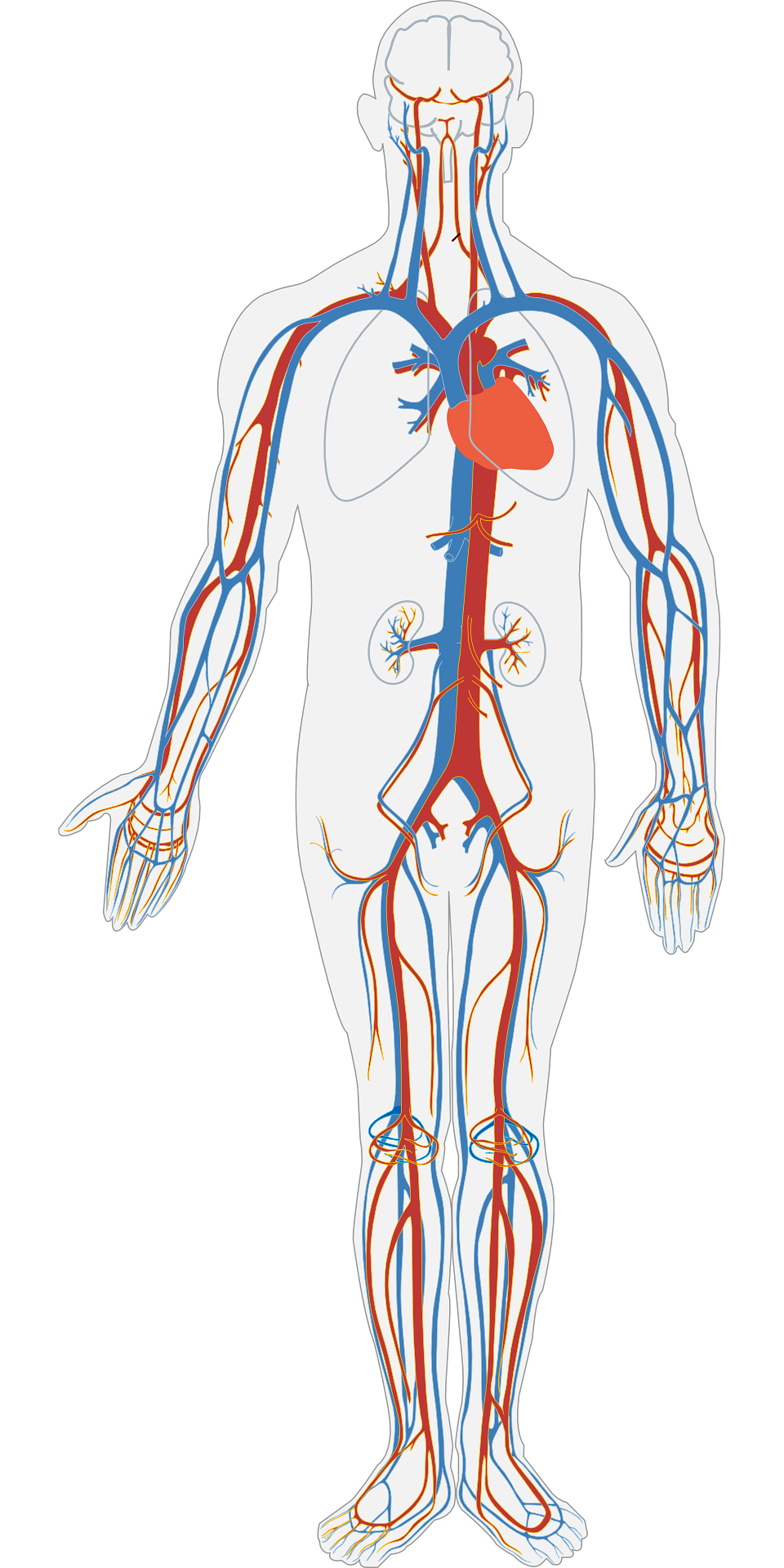
This article focuses on step #3: deoxygenated blood traveling back toward the heart.
The Skeletal Muscle Pump
Blood pressure regulation is a complex, involuntary process controlled by multiple bodily systems. However, there are ways to consciously cause a temporary increase or decrease in blood pressure. Introducing: the skeletal muscle pump, a handy mechanism that can temporarily increase blood pressure and therefore reduce lightheadedness caused by a sudden drop in blood pressure.
The skeletal muscle pump, also known as the musculovenous pump, helps transport deoxygenated blood from the extremities back to the heart (step #3 in the cardiovascular cycle outlined in the previous section). There are three primary components involved in the skeletal muscle pump mechanism:
Skeletal muscles (like your calves, quads, and glutes). Skeletal muscles are the muscles we consciously contract to create or stop joint movement.
Deep veins embedded within skeletal muscles (veins are the blue tubes that transport deoxygenated blood from the extremities back to the heart as shown in the previous diagram).
A series of one-way valves inside of deep veins (these one-way valves prevent backflow of deoxygenated blood as the blood fights against gravity to return to the heart (envision deoxygenated blood traveling upward through the feet, calves, thighs, and hips).
Putting all 3 components together: When your skeletal muscles (like your calves, quads, and glutes) contract rhythmically (like when you walk), the cyclical contracting and relaxing of the muscle tissue repeatedly compresses the deep veins inside of the muscles to assist in forcing deoxygenated blood back toward the heart, and the one-way valves inside the deep veins prevent backflow [1]. Voila - the skeletal muscle pump; it’s such an impressive mechanism in transporting deoxygenated blood against gravity that it is sometimes referred to as “the second heart”.
Q: What makes the valves of the deep veins “one-way”? A: Due to the valves’ anatomy, they only open to allow blood flow toward the heart, and they automatically close in the case of backflow (see short video below for a visual representation of the valves’ biomechanics). Some bodily mechanisms are incredibly complex and subtle, but others, like the one-way venous valves, are similar to simple plumbing components you could buy at Home Depot. Fun fact: varicose veins are caused by deformation or weakness in a vein’s valves and walls that allow for backflow and pooling of deoxygenated blood in sections of a vein [2].
With each cycle of muscle contraction and relaxation, deoxygenated blood gets progressively pushed through the series of venous valves and reaches a new, closer-to-the-heart location within the deep veins (and there ain’t no turning back thanks to the one-way valves). The repeated compression of the veins by consciously contracting the surrounding muscle tissue increases the rate of deoxygenated blood returning to the heart, which consequently increases the amount of oxygenated blood pumped by the heart and ultimately leads to an increase in blood pressure (and therefore reduced lightheadedness).
Short video that demonstrates the biomechanics of the skeletal muscle pump:
Here’s a simple breakdown of how the engagement of skeletal muscle pumps reduces lightheadedness caused by low blood pressure [3]:
A temporary drop in blood pressure causes less oxygen being delivered to the brain and resultant lightheadedness.
The repeated squeezing of deep veins by consciously contracting and relaxing the surrounding muscle tissue increases the amount of deoxygenated blood traveling toward the heart.
The increase in venous return (i.e. blood flow back to the heart) increases cardiac output (i.e. the amount of blood pumped by the heart per unit of time).
The increase in cardiac output increases blood pressure.
The increase in blood pressure helps deliver more oxygenated blood to the brain.
The increase in oxygen delivery to the brain reduces lightheadedness.
You don’t pass out in the gym after finishing a heavy set of deadlifts, which prevents embarrassment and being permanently nicknamed “Shaky Sean” or “Dizzy Lizzy”.
How to Use the Skeletal Muscle Pump
Again, blood pressure regulation is an automatic process, but as I just described in the previous section we can temporarily increase our blood pressure by actively engaging our skeletal muscles.
To counteract lightheadedness, the most important skeletal muscle pumps to utilize are your calves, quads, and glutes because:
These are large muscles in the lower body, meaning a relatively large volume of blood can pool in them due to gravity. More energy is required to transport deoxygenated blood back to the heart from the lower body muscles compared to the upper body muscles because of the greater distance from the heart.
Fortunately, large muscles also mean powerful muscles. Each voluntary contraction of the calves, quads, and glutes powerfully compresses the deep veins, which forces deoxygenated blood up toward the heart through the one-way valves in the veins.
The Simple Trick to Reduce Lightheadedness (TL:DR starts here)
Do the following muscle actions simultaneously and in a pulsing fashion where you repeatedly hold tension for ~1-2 seconds and then totally relax for ~half a second.
Do a calf raise.
Squeeze your quads.
Squeeze your glutes.
For extra help, you can squeeze your fists as well.
Here’s a short video of me demonstrating the above technique:
Other things to keep in mind:
Breathe normally (don’t hold your breath).
Forcefully squeeze your muscles each pulse, about 50%-75% of your maximal effort (the more lightheaded you are, the closer to 75% you should squeeze and the more pulses you should do).
Most temporary low blood pressure situations can be remedied by doing just a few pulse cycles of contraction and relaxation, but the optimal amount of pulses depends on the individual and the intensity of their lightheadedness. Therefore, do as many pulses as you need to until you feel stabilized.
This technique can look silly, but not sillier than stumbling around or fainting.
If you want this technique to be less conspicuous, you can exclude the calf raise.
This technique is especially helpful when experiencing a sudden drop in blood pressure during a situation in which:
There isn’t an opportunity to sit or lie down.
There isn’t an opportunity to grab onto anything or lean against something.
You need to stay standing upright for a long period of time without an opportunity to move around (walking naturally utilizes the skeletal muscle pumps in the lower extremities).
You are exposed to something that triggers acute queasiness (e.g. if the sight of blood makes you feel faint).
I first learned about the skeletal muscle pump working as a sports massage therapist. I’d instruct my clients on how to use the muscle pump technique if they felt lightheaded after getting up from the massage table. I’ve personally used the skeletal muscle pump technique many times to counteract lightheadedness caused by a sudden drop in blood pressure, especially right after getting out of a hot tub or finishing a heavy set of a lower body exercise.
There is an entire genre of YouTube videos that shows people passing out in the gym right after completing a set of intense deadlifts, and another genre of grooms and groomsmen fainting due to standing upright near the alter way too damn long while wearing full suits in hot, stuffy churches. Fortunately, thanks to the skeletal muscle pump technique, I have no content to contribute to those corners of the internet (yet).
References
Verma, A. K., Garg, A., Xu, D., Bruner, M., Fazel-Rezai, R., Blaber, A. P., & Tavakolian, K. (2017). Skeletal muscle pump drives control of cardiovascular and postural systems. Scientific Reports, 7(1), 45301.
London, N. J., & Nash, R. (2000). Varicose veins. British Medical Journal, 320(7246), 1391-1394.
Williams, E. L., Khan, F. M., & Claydon, V. E. (2022). Counter pressure maneuvers for syncope prevention: A semi-systematic review and meta-analysis. Frontiers in Cardiovascular Medicine, 9, 1016420.